
The nutrient your body appears built to recognize
L-Ergothioneine is not another trendy antioxidant.
It is a naturally occurring and essential amino acid but humans cannot make it themselves. We must obtain it from food or supplementation.
Yet the human body has evolved a highly selective transport system specifically capable of absorbing, distributing and retaining it.
That alone makes L-Ergothioneine biologically unusual.[1]
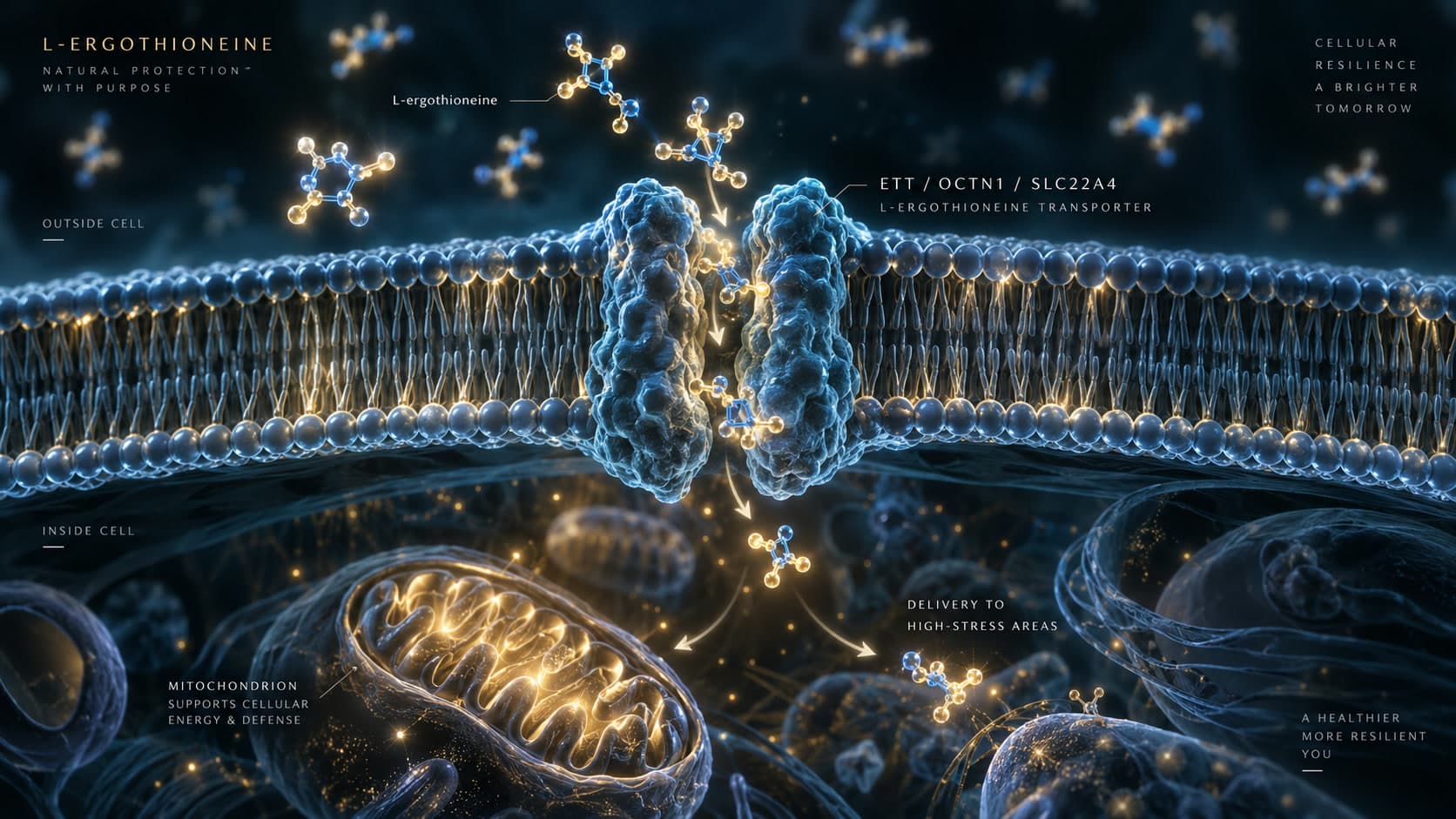
YOUR BODY HAS A TRANSPORTER FOR IT
Most compounds you consume are absorbed, metabolized and eventually eliminated.
L-Ergothioneine is different.
The body uses a specialized transporter called:
ETT
Ergothioneine Transporter
Also known as SLC22A4 / OCTN1
This transporter actively moves L-Ergothioneine across cell membranes.
Its preference for ergothioneine is remarkable. Research found structurally similar compounds were transported dramatically less efficiently, including one at approximately 130 times lower transport and another approximately 25 times lower.[1]
This is not passive absorption.
It is active biological recognition.
WE CANNOT MAKE IT.BUT WE BUILT MACHINERY TO CAPTURE IT.
That is one of the most compelling things about L-Ergothioneine.
Humans do not synthesize it.
Yet our biology includes machinery that:
- absorbs it
- moves it into cells
- distributes it throughout the body
- concentrates it in certain tissues
- reabsorbs it rather than simply eliminating it
- retains it for extended periods
Researchers have explicitly asked the obvious question:
“This implies that ET has a useful function, otherwise why absorb and retain it?”[2]
THE BODY DOESN'T JUST ABSORB IT.IT HOLDS ONTO IT.
This is one of the biggest differences between L-Ergothioneine and many compounds marketed as antioxidants.
Many dietary polyphenols are rapidly metabolized and excreted.
Ergothioneine is highly retained.
Following supplementation in humans, ergothioneine levels increased significantly in plasma and whole blood. Whole-blood levels continued increasing for weeks after supplementation ended, while urinary excretion remained extremely low.[2]
The body appears reluctant to waste it.
YOUR BODY PUTS IT WHERE STRESS IS HIGH
L-Ergothioneine is found throughout the body, but it is particularly concentrated in tissues exposed to high oxidative stress.
These include:
- Red blood cells
- Bone marrow
- Liver
- Kidneys
- Eyes
- Seminal fluid
Research has also found evidence that ergothioneine may accumulate at sites of tissue injury through increased expression of its transporter, ETT/OCTN1.[1]
This has led researchers to propose something fascinating:
L-Ergothioneine may behave as an “adaptive antioxidant.”
Instead of simply flooding every tissue indiscriminately, the body may increase transporter activity where oxidative damage is elevated, allowing more ergothioneine to accumulate there.[2]

WHAT HAPPENS WHEN THE TRANSPORTER IS REMOVED?
This may be one of the strongest clues to ergothioneine's biological importance.
When researchers silence the ETT/OCTN1 transporter, cells lose their ability to properly accumulate ergothioneine.
When the transporter was genetically removed in mice, most tissues became almost completely deficient in ergothioneine.
There did not appear to be another major transport system waiting to take over.[1]
And the consequences were measurable.
Cells depleted of ergothioneine showed increased:
- mitochondrial DNA damage
- protein oxidation
- lipid peroxidation
- susceptibility to oxidative injury[1]
That is a very different story from simply discovering that a compound can neutralize free radicals in a laboratory dish.

IT REACHES THE MITOCHONDRIA
Mitochondria produce the energy that powers nearly every cell in your body.
But energy production also generates reactive molecules capable of damaging mitochondrial structures.
Research has detected ergothioneine in mitochondrial fractions and has reported OCTN1 expression associated with mitochondria.
When OCTN1 was silenced in cells exposed to oxidative stress, mitochondrial DNA damage increased.[1]
That has led researchers to investigate ergothioneine as a potential physiological protector of mitochondrial components.
MORE THAN A FREE-RADICAL SCAVENGER
L-Ergothioneine has demonstrated activity against multiple forms of reactive chemistry.
Research has shown activity involving:
- Hydroxyl radicals
- Singlet oxygen
- Peroxynitrite
- Hypochlorous acid
- Reactive nitrogen species
It can also bind certain metal ions such as iron and copper in ways that may reduce their ability to promote oxidative damage.[1]
But focusing only on antioxidant strength misses what makes ergothioneine unique.
The more important story is:
Absorption. Targeting. Retention. Cellular access.
An antioxidant cannot protect a tissue it never reaches.
THE TELOMERE CONNECTION
Telomeres protect the ends of chromosomes and naturally shorten as cells divide.
Oxidative stress can accelerate that shortening.
Researchers exposed human fibroblast cells to oxidative stress and treated them with ergothioneine.
After eight weeks, ergothioneine-treated cells showed:
- longer median telomeres
- longer short-end telomeres
- fewer critically short telomeres
- reduced rates of telomere shortening
The researchers concluded that ergothioneine demonstrated beneficial effects on telomere preservation under oxidative stress conditions.[3]
This was a cell study, not proof that taking ergothioneine lengthens human telomeres. But it provides another important window into the molecule's relationship with cellular aging.
A MOLECULE ASSOCIATED WITH HEALTHY AGING
Scientists have increasingly investigated ergothioneine because several independent observations point in the same direction.
- It is present throughout human tissues.
- It has a highly specialized transporter.
- The body actively retains it.
- Removing its transporter dramatically reduces tissue ergothioneine.
- Lower ergothioneine status has been observed in some aging-associated conditions.
And its biological properties repeatedly intersect with oxidative stress, mitochondrial function, cellular protection and healthy aging.[2]
SO WHY ISN'T IT A VITAMIN?
That question has attracted serious scientific attention.
Classic vitamins were generally discovered because a clear deficiency produced a recognizable disease.
No comparable human ergothioneine deficiency disease has yet been established.
That means ergothioneine does not currently meet the traditional definition of an essential vitamin.
But some researchers have proposed a broader concept:
a “longevity vitamin”
The idea is that certain nutrients may not be required to prevent immediate deficiency disease, but may still be important for maintaining long-term cellular health and healthy aging.
Ergothioneine has become one of the most discussed candidates.
HOW DO WE KNOW THE BODY VALUES IT?
- Not because of one antioxidant assay.
- Not because of one animal experiment.
- Not because of one marketing claim.
The argument comes from the convergence of biology.
We cannot make it.
Humans depend on external sources.
We have specialized machinery to absorb it.
ETT/OCTN1 provides highly selective transport.[1]
We actively concentrate it.
Ergothioneine accumulates in multiple tissues, including tissues exposed to substantial oxidative stress.[1]
We retain it.
The body excretes relatively little after supplementation and maintains elevated tissue and blood levels.[2]
Transporter expression can increase during tissue stress.
Researchers have proposed that this may help direct ergothioneine toward injured tissues.[2]
Remove the transporter and ergothioneine nearly disappears.
Most tissues in OCTN1 knockout animals became almost completely deficient in ergothioneine.[1]
Remove ergothioneine from cells and vulnerability increases.
Greater oxidative damage to proteins, lipids and mitochondrial DNA has been observed when ergothioneine uptake is disrupted.[1]
NOT ALL ANTIOXIDANTS ARE TREATED EQUALLY BY THE BODY
- Vitamin C is important.
- Glutathione is important.
- CoQ10 is important.
- Polyphenols can be important.
But antioxidant activity alone does not explain ergothioneine.
The body appears to treat this molecule differently.
- It has evolved a highly selective transporter for it.
- It absorbs it.
- It moves it into tissues.
- It retains it.
- It may increase transporter expression when tissues are under stress.
That is what makes L-Ergothioneine different.
THE BODY'S OWN CLUE
There are thousands of compounds in the human diet.
Very few are given their own highly selective biological transport system.
L-Ergothioneine is one of them.
We cannot manufacture it.
Yet our cells have machinery designed to capture it.
That may be the most important clue of all.
The question is no longer simply:
“What can L-Ergothioneine do?”
The more interesting question may be:
“Why did human biology evolve to find it, transport it and keep it?”
References
- 1.Cheah IK, Halliwell B. Ergothioneine; antioxidant potential, physiological function and role in disease. Biochim Biophys Acta. 2012. PubMed 22001064
- 2.Halliwell B, Cheah IK, Tang RMY. Ergothioneine - a diet-derived antioxidant with therapeutic potential. FEBS Lett. 2018. PubMed 29851075
- 3.Samuel P, Tsapekos M, de Pedro N, et al. Ergothioneine Mitigates Telomere Shortening under Oxidative Stress Conditions. J Diet Suppl. 2022. PubMed 33287595